

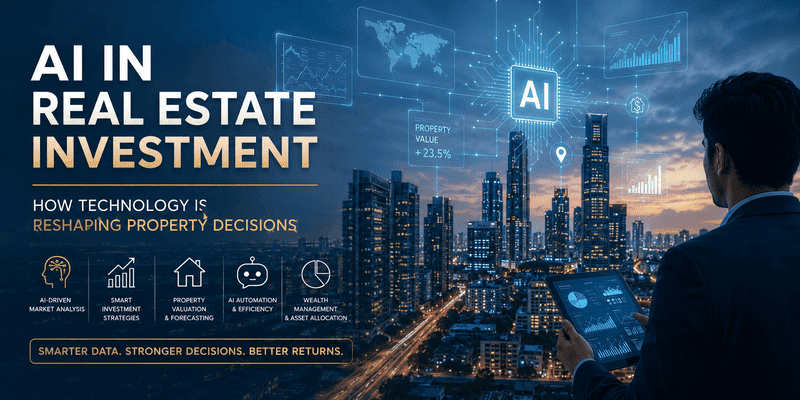
AI in Real Estate Investment - How Technology is Reshaping Property Decisions
AI in Real Estate Investment - How Technology is Reshaping Property Decisions
Artificial intelligence is no longer a future concept in real estate.
It is already changing how investments are analyzed, managed, and executed.
From institutional investors and wealth management companies to individual property buyers, AI is becoming one of the most influential forces shaping modern real estate investment decisions.
According to Morgan Stanley Insights, AI-driven systems are expected to significantly impact capital allocation, investment management, market forecasting, and operational efficiency across global property markets.
The shift is happening because real estate has become increasingly data-driven.
Today’s property markets generate massive volumes of information through:
● Transaction patterns
● Infrastructure activity
● Rental movements
● Consumer demand signals
● Demographic trends
● Market sentiment
● Commercial leasing activity
AI is helping investors process these complex datasets faster and more intelligently than traditional analysis methods.
And this is fundamentally reshaping the future of real estate investment.
Why AI Is Becoming Important in Real Estate Investment
Real estate investment decisions have historically depended on:
● Manual market research
● Historical pricing trends
● Local broker insights
● Developer reputation
● Economic cycles
While these factors still matter, modern property markets are becoming too dynamic for traditional analysis alone.
AI allows investors and financial advisors to evaluate:
● Real-time market trends
● Property demand fluctuations
● Infrastructure impact
● Future appreciation potential
● Rental yield forecasting
● Portfolio risk exposure
This makes investment management significantly faster and more data-informed.
How AI Is Changing Real Estate Market Analysis
One of AI’s biggest advantages is predictive analysis.
Instead of only studying past market performance, AI systems can identify patterns that help forecast future real estate trends.
This includes analyzing:
● Infrastructure expansion
● Migration patterns
● Urban growth corridors
● Office absorption rates
● Consumer buying behavior
● Investment market shifts
For example, AI-driven platforms can identify emerging real estate micro-markets before they become mainstream investment zones.
This is particularly relevant in India, where infrastructure-led development is rapidly reshaping property markets.
AI and Property Valuation Are Becoming Smarter
Traditional property valuation often depends on comparable sales and local market assumptions.
AI is improving this process by evaluating significantly larger datasets in real time.
Modern AI valuation systems can analyze:
● Location growth indicators
● Historical pricing movements
● Infrastructure announcements
● Demand density
● Rental performance
● Commercial activity
● Future development pipelines
This allows investors to make more informed property investment decisions with reduced analytical gaps.
Many real estate investment trust (REIT) platforms globally are also increasingly using AI-supported analytics for portfolio management and acquisition decisions.
Wealth Management Firms Are Using AI for Real Estate Allocation
AI is also influencing wealth management and investment advisory services.
Large financial institutions and wealth management companies are increasingly integrating AI into:
● Asset allocation
● Portfolio diversification
● Investment forecasting
● Risk assessment
● Capital market analysis
This is changing how financial advisors approach real estate investment as part of long-term wealth strategies.
Instead of relying only on static market reports, AI systems now provide dynamic, continuously updated investment insights.
That improves investment management decisions across both residential and commercial real estate portfolios.
AI in Commercial Real Estate Is Expanding Rapidly
Commercial real estate has become one of the biggest beneficiaries of AI automation.
AI systems are now being used for:
● Office demand forecasting
● Occupancy analytics
● Commercial leasing trends
● Operational efficiency
● Smart building management
● Energy optimization
This is especially important as companies rethink workspace requirements after hybrid work adoption.
AI helps commercial real estate businesses understand:
● Which office markets are expanding
● Which corridors are slowing
● Where future demand may emerge
● How tenant behavior is evolving
This enables faster and more strategic investment decisions.
How AI Is Changing Real Estate Business Operations
The real estate business itself is becoming more technology-driven.
AI automation is now improving:
● Lead generation systems
● Customer behavior analysis
● Property recommendations
● CRM intelligence
● Construction planning
● Marketing optimization
● Investment forecasting
For developers and real estate companies, AI is helping reduce inefficiencies while improving buyer targeting and operational planning.
This creates faster decision-making across the entire property lifecycle.
AI in Real Estate Is Growing Rapidly in India
India’s real estate sector is entering an important technology transformation phase.
Several factors are accelerating AI adoption:
● Growing digital property ecosystems
● Infrastructure expansion
● Smart city initiatives
● Rising investment activity
● Institutional capital inflows
● Increased proptech adoption
According to industry analysis from The Print - Agentic AI and Indian Real Estate, AI systems are expected to increasingly influence how Indian real estate companies approach customer engagement, operational planning, and investment decisions.
This shift is particularly relevant for emerging urban markets where infrastructure growth is rapidly changing property demand patterns.
Can AI Replace Human Real Estate Decision-Making?
Despite rapid AI adoption, real estate investment still requires human judgment.
AI can improve:
● Speed
● Data processing
● Pattern recognition
● Risk analysis
● Market forecasting
But human expertise remains essential for:
● Understanding buyer psychology
● Evaluating local market sentiment
● Negotiation strategy
● Regulatory interpretation
● Long-term vision assessment
The future of real estate investment is likely to combine:
● AI-powered analytics
● Human strategic judgment
rather than replacing one with the other.
The Future of AI in Real Estate Investment
Over the next decade, AI is expected to become deeply integrated into nearly every stage of the real estate ecosystem.
This includes:
● Investment analysis
● Property discovery
● Wealth management
● Construction systems
● Smart infrastructure
● Commercial leasing
● Portfolio optimization
● Customer personalization
The real estate industry is moving toward more predictive, automated, and intelligence-driven decision-making.
And investors who adapt early may gain significant advantages in identifying future growth opportunities.
Final Thoughts
AI is not replacing real estate investment.
It is reshaping how investment decisions are made.
From wealth management firms and financial advisors to developers and institutional investors, AI is helping the industry become faster, more analytical, and increasingly data-driven.
As infrastructure expansion, capital markets, and urban development continue evolving globally and in India, AI will likely become one of the defining forces behind future property investment strategies.
The future of real estate investment will not depend only on owning data.
It will depend on understanding it faster and better than everyone else.
Frequently Asked Questions (FAQs)
How is AI used in real estate investment?
AI is used for market analysis, predictive forecasting, property valuation, investment management, portfolio optimization, and risk assessment in real estate investment.
Can AI predict real estate market trends?
AI can analyze large datasets and identify market patterns that help forecast property demand, pricing trends, and investment opportunities.
How are wealth management companies using AI in real estate?
Wealth management firms use AI for asset allocation, investment forecasting, portfolio diversification, and capital market analysis.
Is AI replacing real estate agents and financial advisors?
No. AI improves data analysis and efficiency, but human expertise remains essential for strategy, negotiation, and relationship-driven decision-making.
What is AI automation in real estate?
AI automation refers to technology-driven systems used for lead generation, customer analysis, operational planning, marketing optimization, and investment forecasting.
How does AI help commercial real estate?
AI helps commercial real estate businesses analyze office demand, occupancy trends, leasing behavior, operational efficiency, and market growth patterns.
Why is AI important for future real estate markets?
AI improves speed, predictive accuracy, and investment intelligence, helping investors adapt to rapidly changing property markets.
Is AI adoption growing in India’s real estate sector?
Yes. Increasing proptech adoption, infrastructure growth, and digital transformation are accelerating AI integration across India’s real estate industry.