

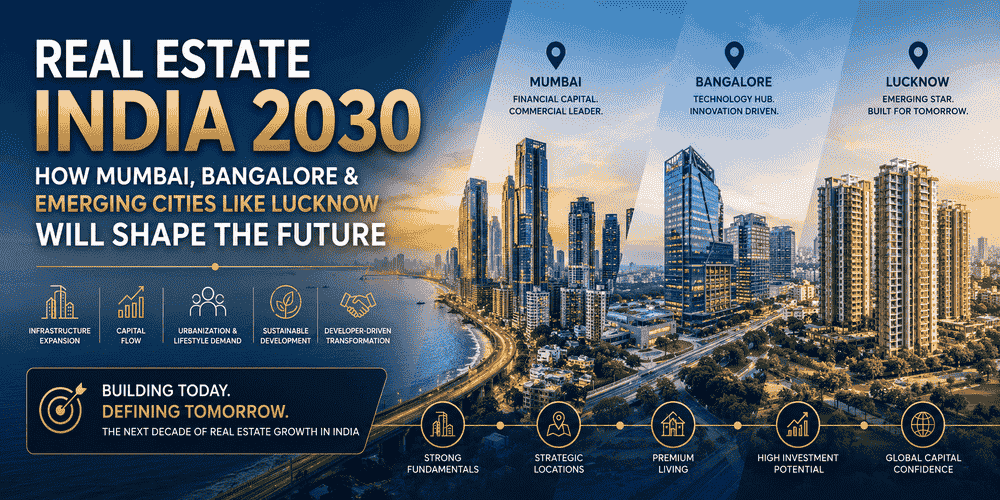
Real Estate India 2030 - How Mumbai, Bangalore & Emerging Cities Like Lucknow Will Shape the Future
Real Estate India 2030 - How Mumbai, Bangalore & Emerging Cities Like Lucknow Will Shape the Future
India’s real estate market is entering one of its most important growth decades.
By 2030, the country’s property market will no longer be shaped only by traditional metro cities. Instead, the future of real estate in India will be defined by a combination of infrastructure expansion, commercial real estate growth, luxury residential demand, and the rapid rise of emerging urban corridors.
According to industry projections from Cushman & Wakefield India, India’s real estate sector is expected to become one of the country’s strongest economic growth engines by the end of the decade.
What’s changing is not just scale.
It’s where the growth is happening.
Mumbai continues dominating commercial real estate investment. Bangalore remains India’s technology and innovation property hub. But emerging cities like Lucknow are rapidly entering the national real estate conversation through infrastructure-led growth and rising luxury residential demand.
The next phase of India property growth will belong to cities that combine:
● Connectivity
● Infrastructure
● Sustainability
● Commercial expansion
● Lifestyle-driven residential real estate
And that shift is already underway.
India’s Real Estate Industry Is Becoming Multi-Centered
For years, India’s real estate business revolved around a few metro cities.
But by 2030, the market is expected to become significantly more decentralized.
Several major trends are driving this transformation:
● Infrastructure-led urban expansion
● Hybrid work ecosystems
● Institutional capital inflows
● Commercial real estate diversification
● Premium residential demand
● Smart city development
● Sustainable real estate planning
This shift is changing both the residential and commercial real estate landscape across India.
Cities are no longer competing only on size.
They are competing on livability, connectivity, and long-term urban planning.
Mumbai Real Estate - India’s Commercial Powerhouse
Mumbai remains India’s strongest commercial real estate market.
As the country’s financial capital, Mumbai continues attracting:
● Global institutional investors
● Enterprise headquarters
● Financial firms
● Commercial office occupiers
● Luxury residential investment
This makes Mumbai real estate one of the most resilient long-term investment ecosystems in India.
Why Mumbai Will Continue Leading by 2030
Commercial Real Estate Expansion
Mumbai dominates India’s premium office market and continues seeing demand for:
● Grade A office spaces
● Commercial property investment
● Mixed-use developments
● High-density business districts
The future of commercial real estate in Mumbai is expected to remain closely linked to finance, enterprise expansion, and infrastructure modernization.
Luxury Housing Demand
The city also continues driving demand for:
● Luxury apartments in Mumbai
● High rise apartments
● Premium residential real estate
● Luxury mixed-use communities
As land availability reduces, redevelopment and vertical luxury growth are expected to dominate the next decade.
Bangalore Real Estate - India’s Technology Growth Engine
Bangalore has become one of India’s most important real estate growth markets because of its technology ecosystem.
The city continues attracting:
● Global technology firms
● AI companies
● Startups
● Innovation hubs
● International office occupiers
This directly fuels both commercial real estate and luxury residential demand.
Why Bangalore Property Markets Will Keep Expanding
Office Space Demand
Bangalore remains one of India’s strongest office leasing markets due to continuous technology-sector growth.
This strengthens:
● Commercial office demand
● Business district expansion
● Commercial real estate investment
Rise of Luxury Apartments in Bangalore
As income levels continue rising, buyers are increasingly searching for:
● Apartments in Bangalore
● Luxury apartments
● Residential high-rise communities
● Sustainable residential projects
The city’s luxury housing market is expected to remain one of India’s strongest through 2030.
Infrastructure-Led Appreciation
Metro expansion, peripheral connectivity corridors, and integrated township development are expected to significantly influence Bangalore property appreciation over the next decade.
Why Lucknow Property Markets Are Entering Their Growth Phase
One of the biggest real estate industry trends today is the rise of Tier 2 cities.
Among them, Lucknow is emerging as one of India’s strongest infrastructure-led residential markets.
Lucknow property demand has accelerated because of:
● Regional infrastructure investment
● Urban corridor expansion
● Improved airport connectivity
● Premium residential development
● Lower-density urban planning
● Growing luxury apartment demand
Unlike overcrowded metro markets, Lucknow still offers the ability to create large-format residential ecosystems with openness, greenery, and modern planning.
Lucknow Projects Are Redefining Residential Real Estate
Lucknow’s next growth cycle is no longer driven only by plotted development.
The city is now witnessing rapid growth in:
● Luxury apartments
● High rise apartments
● Residential real estate
● Luxury apartment complexes
● Integrated gated communities
Micro-markets like Gomti Nagar Extension are becoming major premium residential hubs because of infrastructure projects such as:
● Shaheed Path
● Kisan Path
● Green Corridor
● Airport connectivity expansion
This is changing how investors view real estate Lucknow.
The market is increasingly attracting buyers looking for:
● Larger layouts
● Better ventilation
● Green-facing residences
● Premium amenities
● Lifestyle-oriented housing
Luxury Residential Real Estate Will Define the Next Decade
Across India, luxury housing demand is shifting significantly.
Today’s buyers are prioritizing:
● Larger living spaces
● Wellness-oriented environments
● Open layouts
● Sustainable planning
● Privacy and exclusivity
● Lifestyle amenities
This trend is driving the rise of:
● Luxury apartments
● High rise apartments
● Luxury residential ecosystems
● Premium mixed-use communities
Cities that successfully integrate infrastructure with premium residential planning are expected to outperform in long-term appreciation.
Sustainable Real Estate Will Become a Major Growth Driver
One of the most important real estate market trends shaping 2030 is sustainability.
Developers are increasingly focusing on:
● Energy efficiency
● Open green integration
● Water conservation
● Walkability
● Low-density planning
● Smart infrastructure ecosystems
Future-ready residential and commercial real estate projects are expected to combine sustainability with lifestyle-oriented urban planning.
This will become a major differentiator in both investment performance and long-term livability.
Commercial Real Estate Will Expand Beyond Traditional Metro Centers
India’s future commercial real estate market is expected to become more distributed.
Instead of concentrating only in metro CBDs, future commercial expansion will likely grow around:
● Peripheral urban corridors
● Integrated townships
● Infrastructure-linked clusters
● Emerging business ecosystems
Hybrid work models and evolving enterprise requirements are already reshaping how commercial office space is planned and utilized.
What Will Define Successful Real Estate Projects by 2030?
The next generation of successful real estate projects in India will likely be defined by five major factors:
1. Infrastructure Connectivity
Projects near major transport and urban corridors are expected to outperform isolated developments.
2. Lifestyle-Driven Planning
Modern buyers increasingly prioritize openness, wellness, and integrated living ecosystems.
3. Sustainability
Sustainable real estate projects are expected to attract stronger long-term demand.
4. Mixed-Use Development
The future of real estate development will increasingly combine residential, retail, office, and recreational spaces.
5. Developer Vision
Execution quality, planning clarity, and long-term thinking will become key differentiators in the real estate industry.
Final Thoughts
India’s real estate market by 2030 will not belong to one city alone.
Mumbai will continue leading financial and commercial real estate growth. Bangalore will remain India’s technology-driven property powerhouse. And emerging cities like Lucknow are proving that infrastructure-led residential growth is creating entirely new investment opportunities.
The future of real estate in India is becoming broader, smarter, and more experience-driven.
The cities that combine infrastructure, sustainability, commercial growth, and lifestyle-oriented planning will define the next decade of India property development.
And that transformation has already begun.
Frequently Asked Questions (FAQs)
What will drive India’s real estate market by 2030?
Infrastructure expansion, urbanization, commercial growth, sustainability, and institutional investment are expected to drive India’s real estate market through 2030.
Why is Mumbai important for commercial real estate?
Mumbai remains India’s financial capital and continues attracting strong office leasing demand and commercial real estate investment.
Why is Bangalore considered a major real estate market?
Bangalore’s technology ecosystem and office-space demand continue driving strong residential and commercial property growth.
Is Lucknow becoming a strong real estate investment market?
Yes. Infrastructure projects, premium housing demand, and planned urban expansion are positioning Lucknow as a major emerging real estate destination.
What are the biggest real estate industry trends for 2030?
Sustainability, luxury housing, mixed-use developments, and infrastructure-led urban expansion are among the biggest trends.
What is the future of commercial real estate in India?
Commercial real estate is expected to expand beyond traditional metro centers into integrated urban corridors and emerging business districts.
Why are Tier 2 cities attracting real estate investment?
Improving infrastructure, lower density, affordability, and rising livability are attracting both developers and investors to Tier 2 cities.
Why is sustainable real estate becoming important?
Sustainable real estate improves long-term livability, operational efficiency, environmental performance, and investment resilience.